

France: The Path Forward
Chapter 22

Under a beautiful surface, a guide helps me find birds in France and has an important lesson to teach.

I could barely keep up with Frédéric’s pace. An hour into our hike, I was silently cursing.
“Just let me know, and we can turn around,” he said. “Though it’s not far.”
I turned back to my husband, Steve, who was right behind me and whispered, “Let’s go back.”
It had been a year since Iceland. Two years since my pulmonary fibrosis diagnosis. As the world stumbled out of the Covid nightmare and we all filed back to our offices, I quietly threaded my way through the labyrinth of the healthcare system. Two doctors had become nine. Constant labs, imaging, and appointments. All of it stacked against the presentation decks, reorgs, and office politics I was expected to navigate just as seamlessly. No one at work knew.
France was meant to fix all of that. At least for two weeks.
After two cancellations and an Iceland detour, we had finally made it to France.
We were in the Parc Naturel Régional de Camargue in the South of France hoping to find a breeding colony of Slender-billed Gulls and Gull-billed Terns. We had already seen them earlier that week when Steve and I had been birding in the Languedoc area but Frédéric was keen to show us this bird colony. My patience wasn’t so keen.
Frédéric kept moving and Steve gave me a little nudge of encouragement, so we forged forward on the trail.
“Trail” was a rather loose term. There used to be a path, Frédéric explained, but no one had been on it since before the pandemic. It was now overgrown with bushy, waist-high grasses and brambles we pushed out of our way as we stepped through on lumpy, uneven ground we couldn’t see.
Frédéric’s thick white hair spilled out under his sun-bleached baseball hat. He wore a white button-down shirt and brick-red shorts and seemed unaware his legs were bleeding from the thorny brambles. Steve and I wore sensible, long khaki pants adventurers would wear, though I hardly felt like an adventurer. I tripped over prickly branches that sometimes curled like vines around my ankles as if reaching out and grabbing me.

This was not how I wanted to spend my vacation time. As a corporate communicator, I strung words together to deliver messages from the top — writing what was expected though I knew how much it left unsaid. Hanging on to my integrity was like trying to hold steam in my hands.
Work had become insufferable. The trail felt impossible. Why was I plodding through dense, prickly scrub instead of enjoying a plate of cheese?
Frédéric kept his pace. A stream of red trickled over a large scar and abnormal indentation on his right calf as he charged forward.
“What happened?” I asked, pointing at his leg.
“I fell over 20 meters off a cliff in Corsica. I was 23 while doing fieldwork and bird surveys. I spent months in the hospital after that. People said I should have died. I didn’t. I loved my work and went back to it as soon as I could.”
Bushwhacking through tall grass and brambles was no big deal for him.
I couldn’t say the same. I had lost that sense of purpose somewhere along the way—for a paycheck, a bonus, and a share price I watched fall every morning.

Years of birding in hot, humid jungles of Central and South America had left me imagining France would be gentler. I had dreamt of strolling through vineyards and orchards looking for birds in France, occasionally stopping for a picnic of baguette and cheese. Different than the steamy jungles. Different than the office.
After all that tripping and fighting with thorny branches, I asked Frédéric, “How much further?”
“See that building over there?” It was an abandoned small stone structure no bigger than a roadside fruit stand, about a football field away. “That’s where we’re going.”
“What will we find?” I had already forgotten which birds we were hoping to find.
He smiled. “I don’t know. We’ll find out!”
If he didn’t know, why were we continuing with this hike? I thought.
I tasted reflux, bitter and familiar, rising in my throat. Since becoming ill, my body had developed its own vocabulary — a new language for telling me when enough was enough. And I couldn’t take my eyes off Frédéric’s bloody legs, so I stopped. I’d had enough.
“I think I’m done. I’d like to go back,” I said as a declaration, wiping my sweaty forehead with my bandana.
“Oh!” he said with a smile. “Then let’s go back!” I was surprised by his amiable response. As we turned around on the trail toward our car, I checked with Steve to make sure he was okay that I made the call. He nodded.
Steve drove our rental car and Frédéric guided him from the passenger seat to a restaurant only a local would know. It was the kind of place that looked like the trees had simply decided to open for lunch — enormous figs and palms forming a canopy over mismatched tables and chairs, a rusted corrugated roof barely visible beneath the sprawling branches. Terracotta pots and hot pink bougainvillea spilled into every corner. Gravel underfoot with dappled light overhead.
A couple in their 80s ran the outdoor restaurant. The wife worked the tables, kissing guests on their cheeks, talking about the fresh fish and the new pieces of art sculptures in their gift shop. The husband sat at a table with an old metal till full of Euros as he made change for the servers. Everyone knew him and shouted out to him.
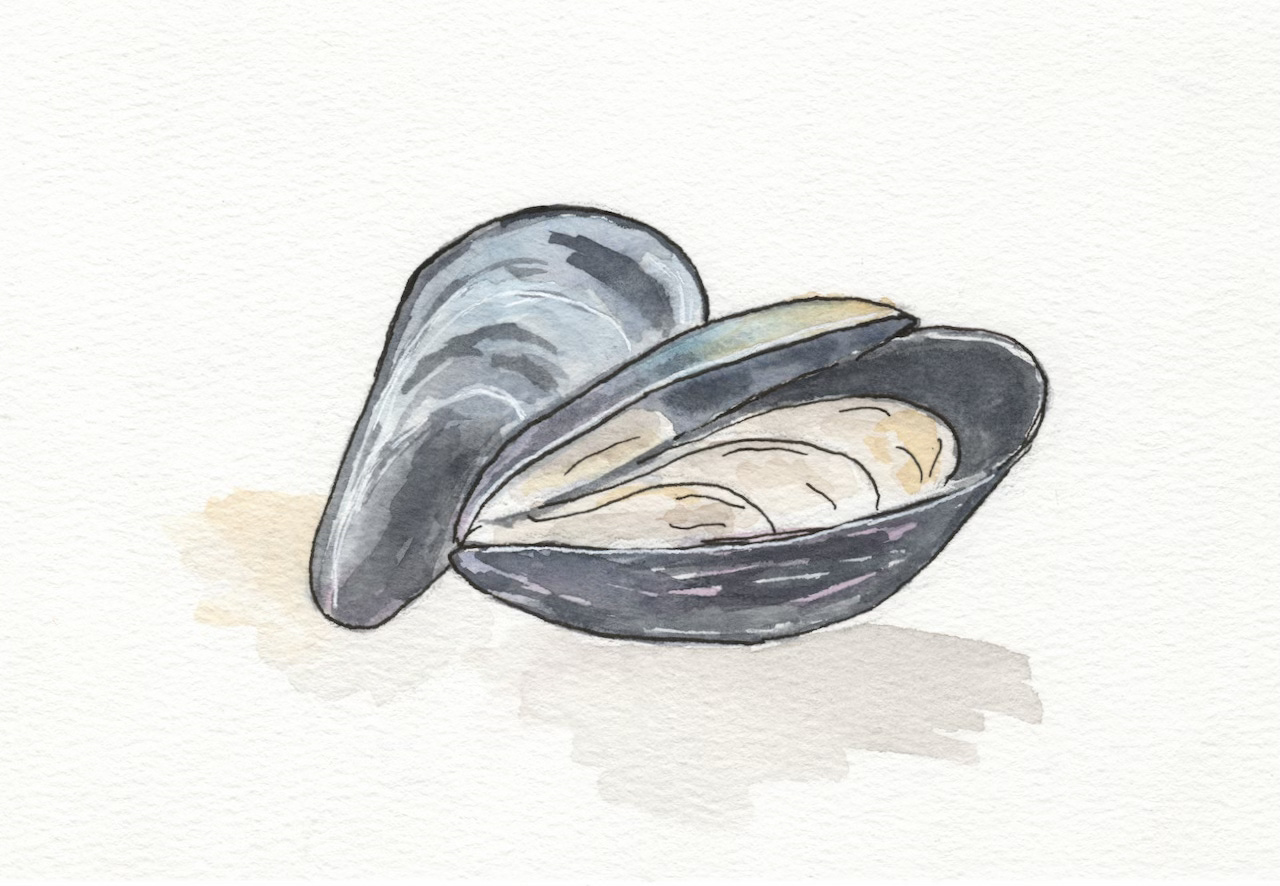
We started with mussels at Frédéric’s suggestion. When the mollusk met my lips I swooned at the perfect combination of white wine, garlic and butter. They hinted at their familiar earthy mushroom flavor but still tasted of the ocean.
The hike was a distant memory as soon as our plates of fish arrived, accompanied by buttery potatoes and a grilled tomato. My fish, fully intact, face and all, looked as though it was smiling, having fulfilled the measure of its creation.
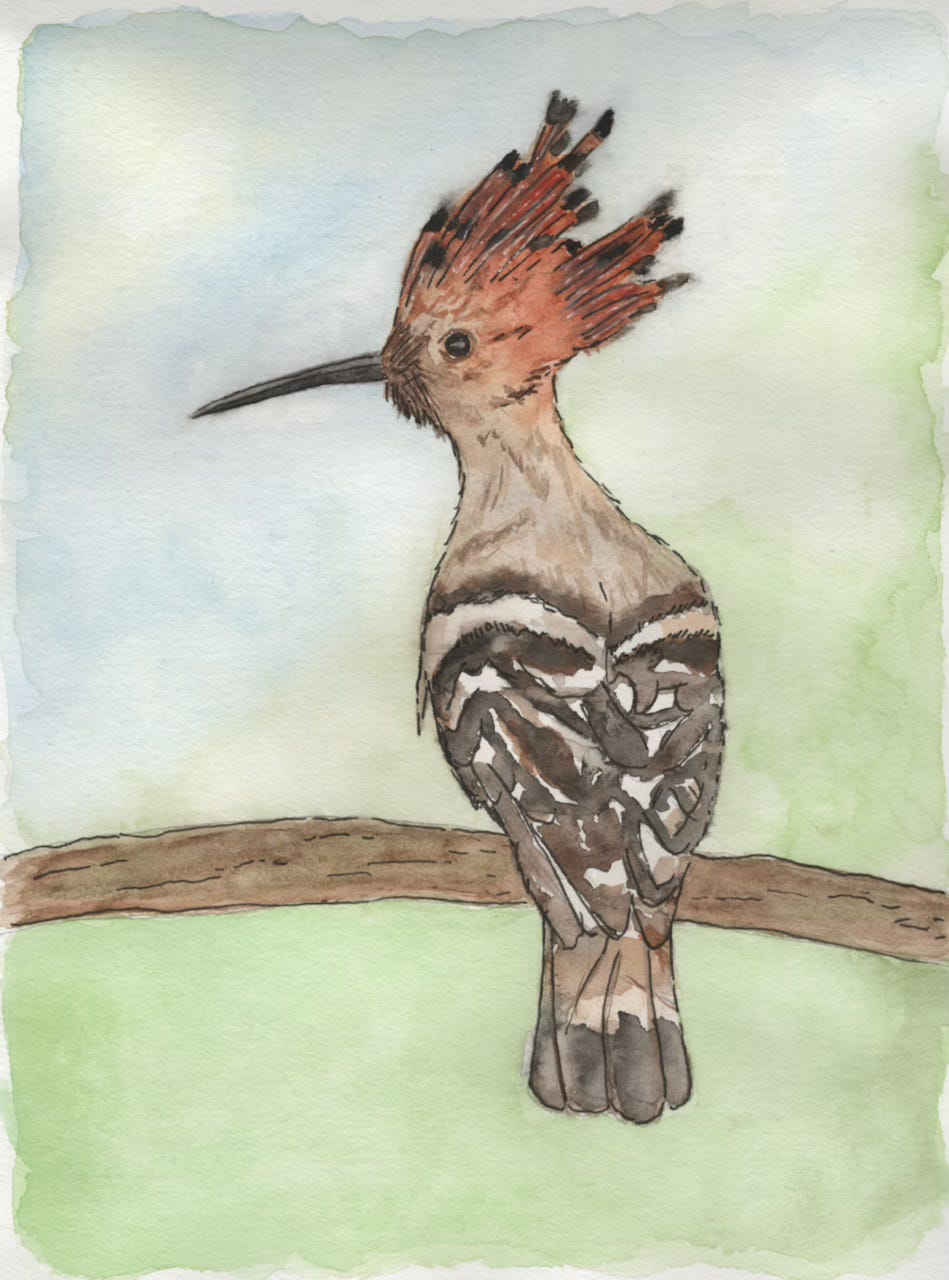
“What birds have you seen in France, so far?” Frédéric asked. “Have you seen the Eurasian Hoopoe? Did you get European Bee-eater? What about the Eagle Owl?”
Yes, to all of those. We had seen them in the Languedoc area the week earlier. By the time we met Frédéric, we’d already seen much of what he planned to show us, except for the flamingos.
“Excellent!” he said, pronouncing it the French way. He didn’t mind at all.
The server cleared our plates and Frédéric announced, “Now let’s go see some flamingos! They are very special here and won’t require a walk at all.”
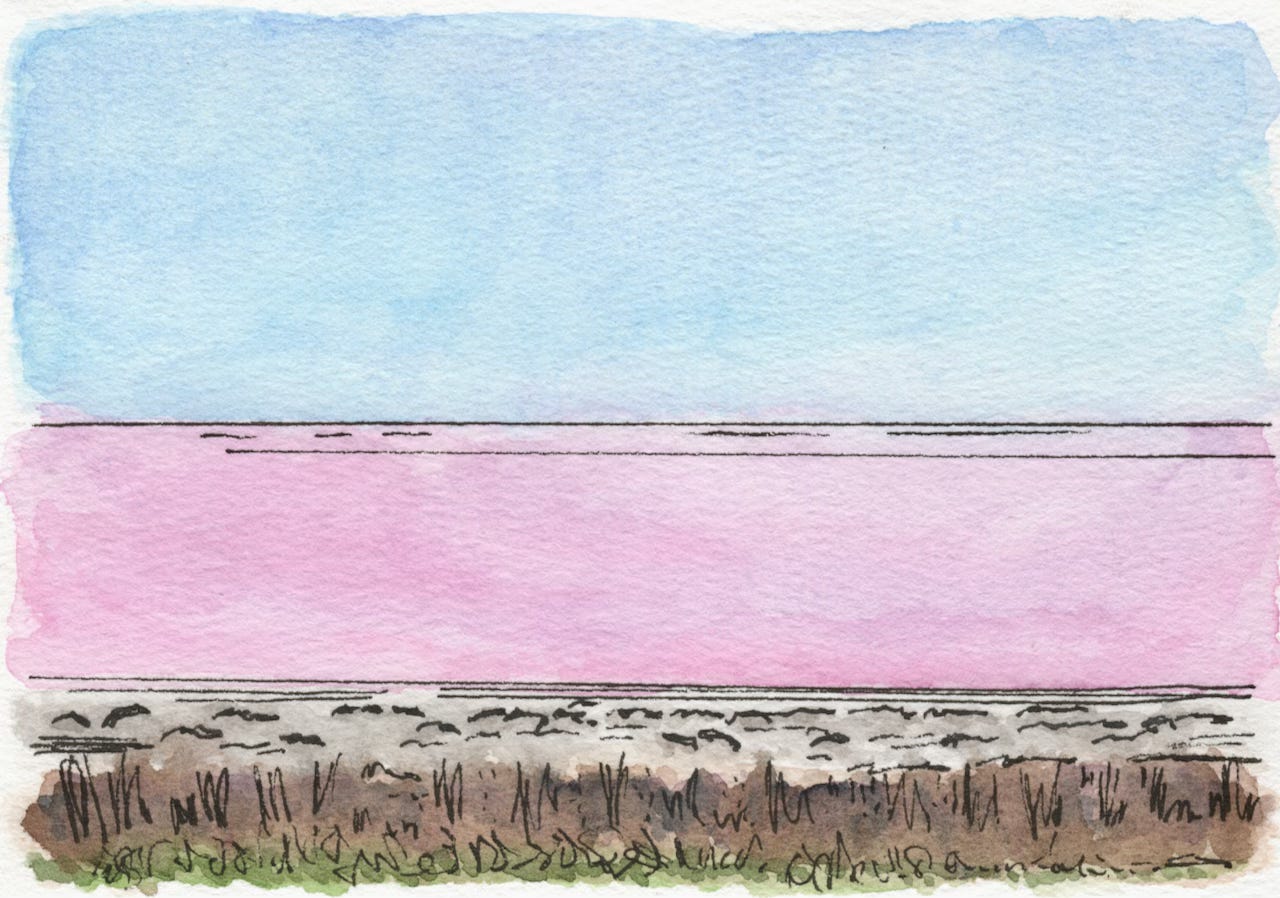
We were in Salin-de-Giraud and only a few minutes from the salt pans managed by Salins du Midi. When we arrived, it was as though I had stepped into a child’s drawing of a landscape with the water colored by a pink crayon. In a child’s mind, there are no rules to follow. The world can be any color.
From the parking lot overlook, I scanned the pink water, sectioned off into blocks, creating a grid that covered a couple hundred hectares. These salt pans held water from the Mediterranean Sea, left to evaporate under the sun until the salt grew denser and denser. In late summer, after much of the water has vanished, sauniers (salt workers) harvest the salt—a practice more than 2000 years old.
The water in the Camargue is pink from the phytoplankton that thrive in the high salinity brine. It attracts Les Flamants Roses (what the French call them) or Greater Flamingos (their official name in the bird field guide), which specialize in eating the salt-water-loving phytoplankton. And it turns their plumage pink.
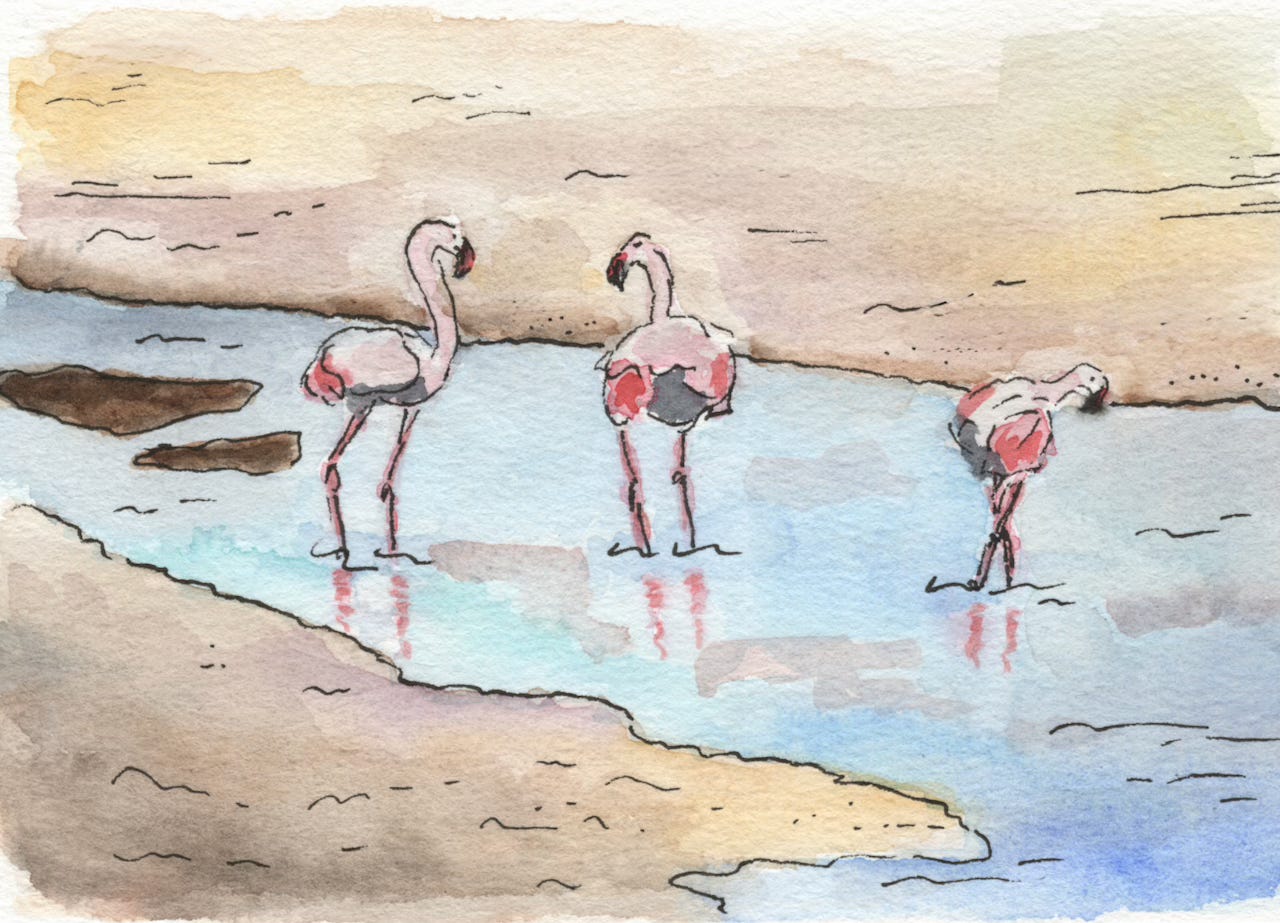
A group of Greater Flamingos tip-toed in the blue water just outside the salt pans. Their long necks curved down as they swooshed their big beaks in the waters to feed. Different from the all-over coral pink American Flamingos I’d seen in the Caribbean and Yucatan peninsula, Greater Flamingo bodies were mostly white with hints of pink. But when they took flight the jellybean pink underneath their wings was unmistakable and punctuated the sky as if a flower bloomed wide open against the clouds.
For a few minutes, I wasn’t thinking about any of it — the job, the doctors, the labs. There was only pink.
The next morning, Steve and I met Frédéric at his home. His simple one‑level house sat at the end of a dusty road, tucked under a cluster of trees. It was unadorned, built of plain siding, the kind of place that matched his modest, practical way of living. We parked and he came out dressed in the same uniform as the day before— a white button-down shirt and brick-red shorts.
“We’ll take my car today,” he said. “And since you have already seen most of the birds I’d planned to show you, we will instead begin our day with Provençal culture.”
I climbed into the back of his little 4‑door Renault sedan and Steve rode shotgun so he and Frédéric could talk birds. He took us to Les Baux de Provence, a medieval hillside village in the Alpilles mountains. We arrived early enough for good parking with only a smattering of other visitors and hiked a trail that wrapped around the hill and led us up to the village’s cobblestone pedestrian streets with little tourist shops. At a café we sat at a table overlooking Provence’s symphony of greens—apricot groves, almond orchards, and vineyards. This was exactly what I had been wanting. I sipped my Orangina and ate a pain au chocolat slowly. I heard no complaints from Steve as he relaxed in his rattan French bistro chair with limbs slumped like a cat ready to take a nap, and nothing but crumbs left on his plate.

Next stop after Les Baux was the village of Eygalières, with its beautifully maintained ancient stone buildings, French blue shutters, and vines hugging the walls. Sitting under red umbrellas at a café, we sampled goat and ewe cheeses accompanied by olive tapenade atop baguette toasts. When our salad bowls full of greens, charcuterie, cheese, tomatoes, honeyed vinaigrette, and pine nuts arrived, Frédéric asked us what we did for a living.
“Oh, where do I work?” I asked.
“That is different,” he said. He sat back in his chair with a wistful look in his eyes, gesturing with his hands while he spoke as though directing a lyrical sweet symphony. “In France we have a saying: On perd sa vie à la gagner — ‘One loses his life by earning it.’”
He laughed and let it hang in the air. But it all felt out of reach for me.
I longed for the freedom to actually live my life and choose what I wanted to do. To linger at lunch, spend an afternoon watercolor painting, or help a family member or neighbor in the middle of the day. To spend a whole day looking for birds in the middle of the week seemed only attainable at retirement.
I envied Frédéric. His modest home. His work in the field that he loved so much. He gleamed with excitement as he showed us Provence and the Camargue. Perhaps the little French saying is why he didn’t flutter when I wanted to bail on the hike the previous day. Or when we told him we had already seen all the birds he’d planned to show us.
I reached for the last bit of goat cheese and toast. Was I working? Was I living? I had cleared my head of meetings, emails, and all the words I wrote that weren’t my own. I couldn’t say I was living my life at all. It felt more like a chore. And I resented thinking about my corporate job in this lovely little postcard village in Provence.
“I’m retired” Steve said, breaking the silence.
“I write stuff for a big company,” I said. Then I shoved a big forkful of salad into my mouth to end the topic.
After lunch, Frédéric told us he was taking us to a location he asked us to keep secret.
“There is a Bonelli’s Eagle nest, and we want to protect it,” he explained.
Steve assured him we would not share the location. I promised not to post it on my social media.
We drove for an hour past vineyards, turning onto a dirt road near a grove of pear trees at the bottom of a mountain cliff. After a short walk, Frédéric pointed out the nest on the cliff’s edge. He set up his scope on its tripod and I peered through it to see two juvenile eagles on a nest made of branches and twigs. One at the back while the other stood at the front, stretching its legs and flapping its wings. The young eagle at the front called, amplified by the valley below as it begged for food. But it was the adult birds—the parents— we came to see, and they were nowhere to be found.
“I’m going to walk down a bit to look from a different place,” Frédéric said. “You two stay here with the scope and let me know if you see anything.” We scanned for eagles, our noses pointed up looking left, right and all around. Not long, my neck and back hurt so I laid on the ground, looking up at the sky through the branches of a pear tree. I thought of Frédéric. His question from lunch, his fall from the cliff, his long recovery, and how he went straight back to the work he loved.
How would I lose my life by earning it? Was I working for a living or living to work? And if it was the latter, what did I want to live for? Do I earn a living to have money to fill a closet full of clothes? A nice car? To pay bills? Or do I earn my life? The French have expressions that always seem like a riddle to me, and I tried to untangle it under that pear tree.
“They’re here!” Steve shouted.
I quickly stood up, looked to the sky, and there they were. The male and female adult Bonelli’s Eagles.
Their long, slender dark wings splayed out from their cream-colored bodies as they soared. They each had food for their young and took turns bringing it to the nest. The female—the larger of the two—even returned with another stick for the nest. They occasionally perched on the side of the cliff and then left to look for prey, perhaps rabbits or partridges, to bring back to the nest.
I followed the eagles with my binoculars, scanning from the male then to the female and then back to the nest. “Wow!” I said to no one in particular.
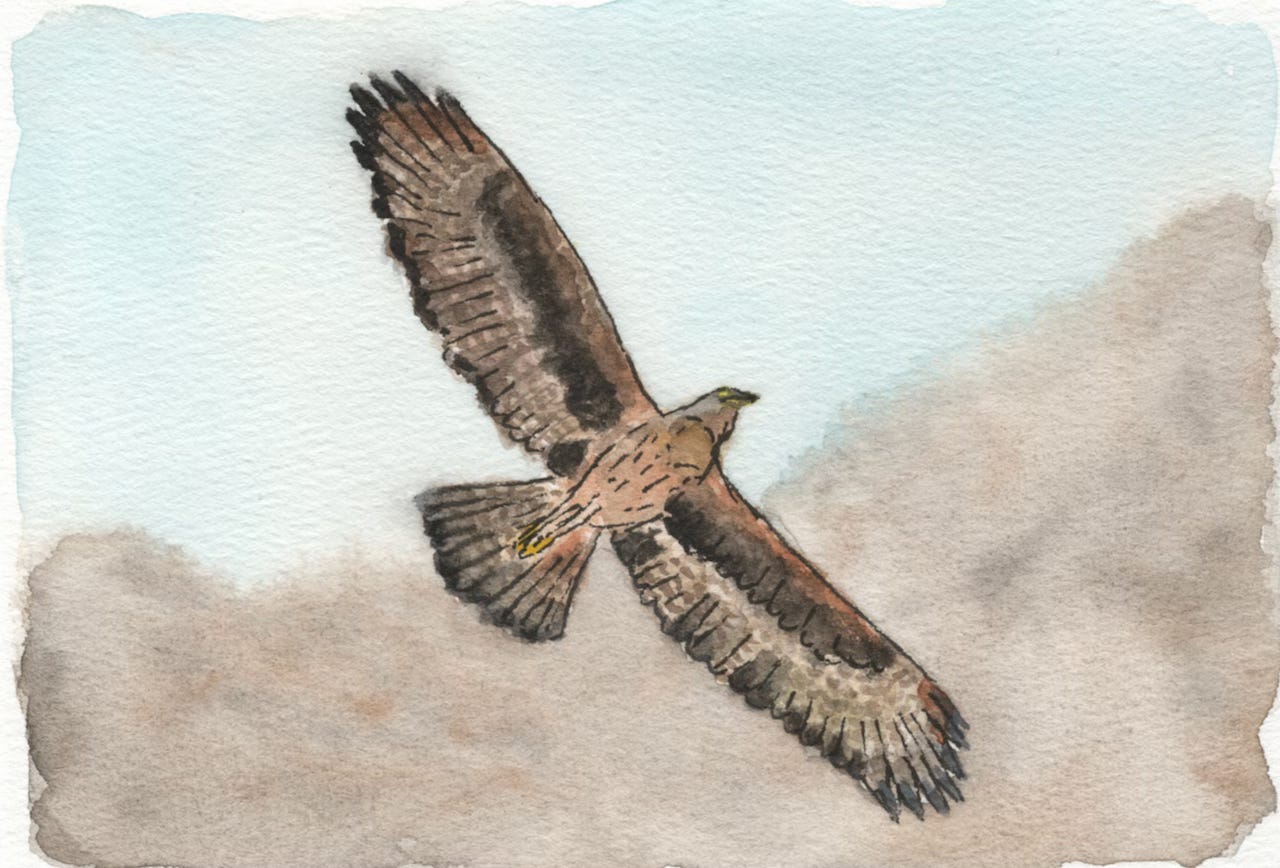
These eagles have purpose. Every action they do is to survive and help their young to thrive. For the bird world it’s simple: get food, avoid predators and don’t die. Sometimes they soar, looking for thermals to lift them higher. Other times they flit around in the breeze for no apparent reason except to enjoy it. Oh, to be like them. I need to find a breeze to lift me up.
Frédéric came running back to us. “Did you see them?”
“Yes!” I said with a big smile. Looking through my binoculars again I followed one of the pair and tried to imprint the bird into my heart.

After returning from France, it felt like I had walked through a door. Behind me: slow-moving, thoughtful little quests of looking for birds in vineyards, eating cheese, and overlooking Provence. On the other side of that door was the room of endless PowerPoint presentations, emails, and rumors of corporate restructuring.
I watched the company stock price continue its fall. I fell back into sleepless nights and my workload seeped into my weekends and evenings. Then four months later it happened. After 18 years with the company, I was let go.
It wasn’t personal they told me. It was just reorganizing, though it still stung. I immediately felt lost. In one moment, my identity, routine, income, and community vanished.
As I packed up my personal items from my office, I unpinned a picture from my bulletin board. It was a scene of the South of France I had put there two years earlier in anticipation of our trip and as a motivation to get through all the work.
The time in Provence swirled in my mind. Soaring Bonelli’s Eagles and the Camargue’s pink waters, all the cheeses I ate, the view of Provence from Les Baux, and that frustrating hike through overgrown brambles as Frédéric forged a path with bloodied legs.
“What will we find?” I had asked, wondering what was at the end of that trail.
“I don’t know. We’ll find out!” he’d said.
Not the answer I wanted then, but the answer I needed now.
On perd sa vie à la gagner.


Hi Lisa! Thank you for sharing your struggles with work + health! I worked in tech for 5 years and towards the end developed health issues that ultimately led me to have to leave the job, and I spent another 3 years trying to figure out what to do with myself / crafting a smaller life that did not stress me out so much. Still trying to figure out the right balance, but birds and writing are a big part of it! Sending you good vibes and much appreciation!